

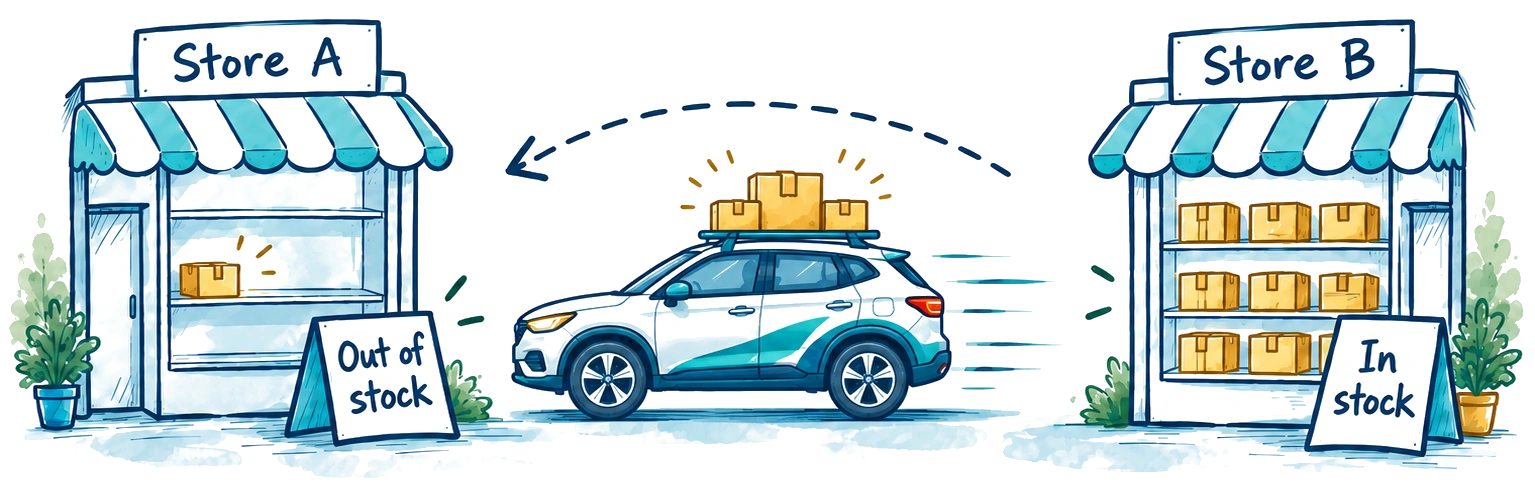
Imagine a customer shopping online for a product that appears unavailable for same-day delivery. The retailer’s local fulfillment location has run out. Yet another branch, just 12 miles away, has six units sitting on a shelf.
The product exists. The customer wants it. The retailer has already paid to stock it.
The missing piece is the inventory transfer: getting that stock to the right location, at the right time, without spending more on transportation than the sale is worth.
Over the past two years, our customer-discovery conversations with e-commerce logistics executives, distribution specialists and multi-location business operators have revealed an interesting contradiction: businesses can have too much inventory in one location and not enough in another. And moving a few boxes across town can sometimes be more complicated than moving thousands of packages across the country.
E-Commerce Has a Geography Problem
U.S. retail e-commerce sales reached approximately $340.2 billion in the second quarter of 2026, accounting for 17.1% of total retail sales on a seasonally adjusted basis.
Yet customers rarely care where their order originates. They care whether the product is available and when it will arrive.
In DHL’s 2025 E-Commerce Trends Report, 76% of surveyed U.S. online shoppers said they would abandon a purchase if their preferred delivery option was unavailable.
For a retailer operating several stores, warehouses or fulfillment locations, this creates a difficult balancing act. Stock everything everywhere, and inventory costs climb. Concentrate inventory in fewer locations, and local availability suffers.
The challenge is no longer simply how much inventory a business owns. It is where that inventory needs to be.
What 10,000 Packages an Hour Taught Us
During a visit to a major e-commerce carrier’s distribution facility, we discussed the economics of large-scale parcel operations.
The executive explained that the facility’s automated systems could process approximately 10,000 packages per hour, while customer volumes around 200 packages per day helped justify the economics of that particular operation.
But in another conversation, a parcel-industry veteran pointed out that many smaller online merchants ship just two to ten packages a day.
That contrast stayed with us.
Large carriers have built remarkable systems for moving enormous parcel volumes efficiently. Small businesses operate differently. Demand fluctuates, inventory is distributed unevenly, and urgent movements rarely arrive in convenient batches.
One day, a merchant needs to relocate ten boxes between stores. The next, a fulfillment center needs an urgent replenishment of a bestselling product.
Neither shipment fills a truck. Both may be too important to wait.
A Stockout Costs More Than One Sale
The immediate consequence of unavailable inventory is obvious: a disappointed customer and potentially lost revenue.
But the longer-term cost is less visible.
A 2025 study published in the Journal of Retailing examined online grocery fulfillment failures. Researchers found that when out-of-stock items forced a substitution, a partial delivery or a refund, customers waited 7.22% longer, on average, before placing their next order.
That finding comes from grocery retail, but it illustrates a broader risk: disappointing fulfillment experiences can change future purchasing behavior.
Sometimes the problem is genuinely insufficient inventory. Other times, the merchandise exists somewhere else in the network but cannot reach the fulfillment location in time.
In that second situation, a quick inventory transfer can make the difference.
The Economics of Moving Inventory Instead of Losing Sales
Consider a hypothetical retailer with four units of a popular product available at a neighboring branch.
Assume each fulfilled sale generates $35 in contribution after product costs and other variable selling expenses, excluding the proposed inventory transfer.
If moving those units locally costs $65, the economics look like this:
- Four recovered sales × $35 contribution = $140
- Same-day inventory transfer = $65
- Potential incremental contribution after transportation = $75
At that contribution level, recovering just two otherwise-lost sales would cover the delivery cost.
Of course, this only works if the inventory transfer actually protects sales that would otherwise disappear. Moving inventory unnecessarily creates expense rather than savings.
That is the essential distinction.
The value of a delivery should be measured against the business outcome it enables, not merely the weight of the boxes being transported.
The Hidden Cost of Moving Inventory Yourself
Another multi-location business operator we spoke with described a familiar arrangement: branches regularly send equipment and merchandise to a central location and bring items back.
The process works, but it consumes an employee and a company vehicle.
For one urgent item weighing 50–80 pounds, sending a truck across the region can seem disproportionate. Yet postponing the movement may delay the operation that depends on it.
E-commerce specialists raised another concern: same-day delivery networks need enough shipment density, reliable drivers, predictable handoffs and effective tracking. An attractive software interface alone cannot solve those operational challenges.
And returns make the picture even more complicated.
According to the National Retail Federation, approximately 19.3% of online sales were expected to be returned in 2025. Products returning to the wrong location, awaiting inspection or needing redistribution represent another inventory transfer challenge.
Where Woosh Fits in E-Commerce Inventory Transfer
We do not believe Woosh should compete with established parcel networks to deliver every $20 online order.
The more interesting opportunity lies between traditional parcels and palletized freight: same-day, local business-to-business inventory transfers that are too small for freight but too urgent for tomorrow.
Woosh’s current platform supports shipments up to 250 pounds, with booking, live tracking, pickup and delivery photographs, signature capture and a digital chain of custody.
For e-commerce businesses, that creates several practical applications: moving a batch of bestselling products between stores, replenishing a local fulfillment point, transferring merchandise from a supplier to a merchant, or consolidating eligible returns for redistribution.
Rather than dispatching a dedicated truck for every small movement, Woosh matches shipments with suitable available vehicle capacity.
The longer-term opportunity is even more interesting. Planned WooshHubs could serve as mobile consolidation points, positioning inventory closer to demand and coordinating movements between suppliers, warehouses and neighborhood fulfillment locations. That remains a future capability, not a service we claim to operate at scale today.
The Next Competitive Advantage May Be Inventory Mobility
Our conversations have changed how we think about e-commerce logistics.
The industry has spent years improving websites, checkout experiences, warehouse automation and delivery speed.
But even perfect inventory data cannot physically move a product from one location to another.
For businesses operating multiple locations, the next opportunity may not be stocking more merchandise everywhere. It may be making existing inventory easier, faster and more economical to reposition.
In e-commerce, a product sitting in the wrong location can be almost as useless as a product that does not exist. Sometimes the difference between an abandoned cart and a completed order is simply getting a few boxes across town.
Enjoyed this? Get Woosh insights on commuting, freight, and smarter logistics in your inbox.
Subscribe to our newsletter